
Missing a tooth and not sure what to do next? A tooth implant can restore chewing function and appearance, but it is not always the right choice for every patient.
This guide explains how a tooth implant works, who is suitable, what recovery is like, and what affects cost in Singapore.
If you want a treatment-specific overview first, read WeSmile’s Dental Implant Cost Singapore page.
What is a Tooth Implant?
A tooth implant is essentially an artificial root made of biocompatible titanium that is surgically placed into your jawbone. This provides a rock-solid foundation for a replacement tooth, known as a crown, which is designed to match your existing teeth.
Understanding the Anatomy: What is a Tooth Implant?
To understand how tooth implant works, it helps to look at the three distinct parts that make up the system. It is not just one screw; it is a collaborative assembly of components.
- The Fixture: This is a small post, usually made of titanium. It acts as the artificial root. Titanium is used because it is biocompatible, meaning your body is unlikely to reject it.
- The Abutment: Think of this as the connector. It is a small piece that sits on top of the fixture and holds the new tooth in place.
- The Crown: This is the visible part. It is the custom-made ceramic tooth that looks, feels, and functions like your natural tooth.
Tooth Implant Steps: From Consultation to Final Crown
The process of tooth implant follows a four-stage progression:
- Consultation & Imaging: We need to see what is happening under the gum line using 3D scans.
- Surgical Placement: The titanium fixture is inserted into the jawbone.
- Osseointegration: This is the critical healing phase where the bone fuses to the metal.
- Restoration: Once healed, the abutment and custom crown are attached.
Benefits of Tooth Implants & Who Are the Ideal Candidates?
Choosing a tooth implant over other options can change your daily comfort and long-term oral health.

Key Advantages Over Traditional Solutions
When comparing implants to older methods like bridges or dentures, the differences are found in long-term stability.
- Bone Preservation: When you lose a tooth, the jawbone tends to shrink over time because it lacks stimulation. Implants replace that root stimulation, which may help maintain facial structure.
- Protection of Healthy Teeth: Unlike a dental bridge, which requires grinding down adjacent healthy teeth to act as anchors, implants stand alone.
- Stability: There is no slipping or clicking, which can sometimes happen with removable dentures.
Who is Suitable for Tooth Implants in Singapore?
You are usually a suitable candidate if:
- You have one or more missing teeth.
- Your jawbone has reached full growth.
- There is adequate bone to secure the implants (or you are open to having a bone graft).
- Your oral tissues are healthy.
Who Should Not Get Dental Implants?
Certain conditions can interfere with the bone-healing process, making the procedure riskier or less likely to succeed.
- Heavy Smokers: Smoking significantly slows down healing and increases the risk of implant failure.
- Uncontrolled Chronic Conditions: Issues like uncontrolled diabetes or heart disease can affect healing.
- Radiation Therapy Patients: If you have had radiation to the head or neck area, specific evaluation is needed.
Types of Tooth Implants Available in Singapore
Implant options vary depending on how many teeth you’re replacing and the condition of your jawbone. Here’s what’s commonly offered in Singapore.

Single Tooth Implant
This is the most straightforward application. If you have lost a single tooth due to an accident or decay, we place one implant and one crown. It essentially fills the gap without touching the neighbouring teeth. It is often the preferred method for isolated missing teeth.
Multiple Tooth Implants & Tooth Bridges Implant
If you are missing several teeth in a row, we don’t necessarily need to implant a separate screw for every single missing tooth.
- Implant-Supported Bridges: We might place two implants to support a bridge of three or four teeth.
- All-on-4 or All-on-6: For patients missing an entire arch of teeth, we can use just four or six implants to support a full set of fixed dentures. This is often more cost-effective than replacing every tooth individually.
Bone Graft for Tooth Implant
Sometimes, a patient wants an implant but the X-rays show there isn’t enough bone thickness to hold the screw. This is where bone grafting comes in.
- Autograft: Using bone from another part of your body.
- Allograft: Using processed bone from a human donor.
- Xenograft: Using bone from an animal source (usually bovine).
This step adds time to the process, as the graft needs to heal before the implant can be placed, but it makes the procedure possible for those who would otherwise be ineligible.
Read related article: Dental Bone Grafts: A Comprehensive Guide
Tooth Implant Procedure Steps: How You Prepare
Preparing for a tooth implant is largely about planning and patience. Most of the heavy lifting is done during the imaging stage to ensure there are no surprises once the surgery begins.
Initial Consultation & Planning
This is where we gather data. You will likely undergo a comprehensive examination and a 3D CT scan. This isn’t just to check the gap but to map out nerves and sinuses. At WeSmile, this phase allows us to give you a precise breakdown of the costs so there are no surprises later.
The Implant Surgery Process
On the day of surgery, the goal is comfort. Most patients do fine with just local anaesthesia—the same stuff used for a filling. The dentist makes a small incision in the gum to expose the bone and places the titanium fixture. The whole thing usually takes about 1 to 2 hours per implant. It is precise work, but for the patient, it is mostly about lying still.
Healing & Osseointegration Period
This is the waiting game. Over the next 3 to 6 months, a process called osseointegration happens. This is where your jawbone actually grows around the titanium post, locking it in place. We usually provide a temporary tooth so you aren’t walking around with a gap during this time.
Final Restoration: Abutment & Crown Placement
Once the implant has fused with the bone, you come back for the final steps. We attach the abutment and then the custom crown. We check your bite to ensure it feels natural when you chew.
Are Tooth Implants Safe? Risks, Side Effects, and Recovery
Safety is a top concern for anyone considering surgery. Tooth implants have strong success rates, but it’s worth understanding potential complications and what recovery looks like.
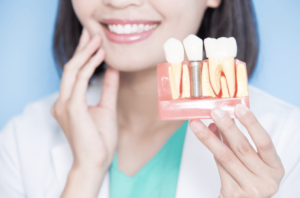
Are Tooth Implants Safe?
Clinical data suggests that dental implants generally have a success rate ranging between 95% and 98%. The materials used, primarily titanium and zirconia, are highly biocompatible. Rejection is rare; failure is usually due to infection or overloading the implant before it has healed.
Managing Tooth Implant Side Effects and Recovery Time
Recovery is often less painful than having a tooth extracted.
- First 48 Hours: You might experience some swelling, minor bleeding, or bruising. Over-the-counter painkillers are usually sufficient.
- Diet: Soft foods are a must for the first week or so.
- Total Recovery: While the gum heals in a couple of weeks, the internal bone healing takes 3 to 6 months.
Alternatives to Tooth Implants: When Implants Aren’t Right for You
Implants aren’t the only way to fix a smile. Sometimes budget, biology, or personal preference points towards other solutions.
Traditional Dental Bridges
A bridge closes the gap by anchoring a false tooth to the natural teeth on either side.
- Pros: Faster to complete than implants and usually cheaper upfront.
- Cons: Requires shaving down healthy enamel on adjacent teeth.
- Lifespan: Typically 5 to 15 years before they may need replacement.
Removable Dentures
These are the classic false teeth.
- Pros: Most affordable option and non-invasive.
- Cons: Can feel bulky, may affect taste, and requires daily removal for cleaning. Over time, because they don’t stimulate the bone, the jaw may change shape, causing the dentures to become loose.
How Much Does a Tooth Implant Cost in Singapore?
In Singapore, dental implant prices can vary widely depending on the complexity of the surgery and the materials used.
How Much Does One Tooth Implant Cost at WeSmile?
At WeSmile Dental, we try to keep things straightforward. Our implant packages typically start from S$2,500. This generally includes the surgical placement and the crown. We also offer a free consultation (worth S$150) to see if you are a candidate, ensuring you don’t waste money if the procedure isn’t right for you.
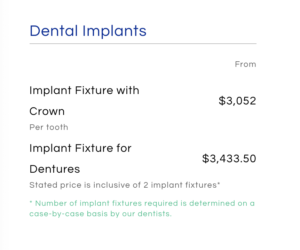
For detailed cost information, visit our price list here.
Medisave Claims & CHAS Subsidies
Many patients ask if they can use Medisave. The answer is yes, but with limits. • Medisave: You can claim up to S$950 to S$1,250 per implant depending on the complexity of the surgery. This helps offset the cash outlay. • CHAS: CHAS subsidies usually apply to the crown portion or related procedures like extractions, ranging from roughly S$11 to S$625 depending on your card colour (Blue, Orange, or Pioneer/Merdeka Generation).
WeSmile Dental Singapore Pricing & Payment Plans
We understand that a lump sum can be heavy on the wallet. We offer interest-free payment plans to break the cost down into manageable monthly amounts. We also assist with all the insurance paperwork so you don’t have to wrestle with the bureaucracy.
Frequently Asked Questions about Tooth Implant
How Long Can Teeth Implants Last?
With proper brushing, flossing, and regular check-ups, an implant screw can last a lifetime. The crown (the part you chew on) suffers normal wear and tear and may need replacement after 15 to 20 years, much like a filling or a crown on a natural tooth.
Do Implants Feel Like Real Teeth?
Most patients report that once the healing is done, they forget which tooth is the implant. You can eat crunchy apples, chew steak, and brush normally. The sensation is very close to a natural tooth because the anchor is in the bone, not sitting on the gum.
How Long Does It Take to Get a Tooth Implant?
It is not a quick fix. A standard case takes about 3 to 6 months from start to finish. If you need a bone graft, it could take up to a year.
Are Implants Better Than Dentures?
For stability and chewing power? Generally, yes. Implants restore almost full chewing force, whereas dentures usually provide only about 20-30% of natural chewing power.
Are tooth implants painful?
Most patients report manageable discomfort after placement, typically controlled with prescribed medication and home-care instructions.
Will I Be Put to Sleep for a Tooth Implant?
Usually, no. Local anaesthesia is standard and sufficient. However, if you are extremely anxious, IV sedation is available at some clinics to help you doze through the procedure.
Can Implants Get Cavities?
The ceramic crown cannot decay. However, you can still get gum disease (peri-implantitis) around the implant if you don’t clean it. So, while you won’t get cavities, hygiene is still non-negotiable.
Why Choose WeSmile Dental for Your Tooth Implant?
Choosing where to get your surgery is a big decision. At WeSmile Dental, we focus on patient comfort and long-term health rather than quick, sales-driven fixes. Our doctors are multi-lingual, making communication easy, and we operate across three convenient locations in AMK, Bedok, and Orchard. We use modern 3D scanning technology to plan your surgery precisely, aiming to make the process as smooth and predictable as possible.
Ready to see if implants are right for you? Book your dental assessment at WeSmile Dental today.