
A pediatric dentist (spelt “paediatric” in Singapore) is a dental specialist who cares for children’s teeth from birth to adolescence. In Singapore, they complete a dental degree, gain experience as a general dentist, and finish three years of postgraduate specialty training, then register as specialists with the Singapore Dental Council (SDC). They treat early tooth decay, dental injuries, habits such as thumb-sucking, and children who need sedation. Most routine check-ups, cleaning, and fillings for children can also be done by a general dentist, so many children only need a pediatric dentist for more complex care.
Pediatric Dentist at a Glance
Pediatric dentist |
|
| Also called | Paediatric dentist, pedodontist |
| Patients | Children from birth to adolescence |
| Registration | Accredited by the Dental Specialists Accreditation Board and registered as a specialist with the SDC |
| Common reasons to see one | Complex or extensive decay, dental injuries, special needs, very young or anxious children, treatment under sedation |
| Where they work | Specialist private clinics and public centres such as the National Dental Centre Singapore (NDCS) |
What Does a Pediatric Dentist Do?

A pediatric dentist prevents, diagnoses, and treats dental problems in children, and manages how a child’s teeth and jaws develop. According to the National Dental Centre Singapore, paediatric dentists commonly manage:
- Early childhood caries: tooth decay in babies and young children, often linked to frequent sugary drinks or milk at night. Read more about the causes and treatment of tooth decay.
- Dental trauma: chipped, loosened, or knocked-out teeth after a fall or sports injury.
- Oral habits: thumb-sucking, pacifier use, and other habits that can affect how teeth grow.
- Malocclusion: teeth or jaws that do not meet properly, sometimes called a “bad bite”.
- Growth and development problems: missing, extra, or unusually shaped teeth.
- Gum disease in children and teenagers.
Treatments include fluoride varnish, sealants (a protective coating painted on the chewing surfaces of back teeth), fillings, crowns, pulp and root canal treatment, and interceptive orthodontics (early treatment to guide the jaws and teeth before a problem gets worse). Pediatric dentists are also trained in behaviour management, which means helping a child stay calm and cooperative. When a child needs it, they can treat under nitrous oxide sedation (a mild “laughing gas” that helps a child relax) or general anaesthesia.
How Does Someone Become a Pediatric Dentist in Singapore?
A dentist becomes a pediatric dentist in Singapore through four steps:
- Earn a dental degree. Obtain a Bachelor of Dental Surgery (BDS) or an equivalent recognised qualification.
- Gain clinical experience. The National University of Singapore (NUS) requires at least two years of full-time clinical experience in general dentistry after graduation, excluding internship.
- Complete specialist training. This is a three-year, full-time postgraduate programme, such as the NUS Master of Dental Surgery (Paediatric Dentistry), with clinical training at the National Dental Centre Singapore and the School Dental Centre.
- Get accredited and registered. The Dental Specialists Accreditation Board (DSAB) assesses the dentist, and the dentist then registers as a dental specialist with the SDC.
Only a dentist on the SDC’s specialist register can call themselves a specialist. Under the Dental Registration Act, as the SDC sets out in its guidance on titles, a dentist may not describe themselves as a specialist unless they are registered as one.
How can you check if a dentist is a registered pediatric specialist?
Search the dentist’s name on the SDC’s online register. Go to sdc.gov.sg and use “Search for registered dentist / OHT”. You can search by full or partial name, or by dental registration number under “More Search Options”. The register lists every dentist with a valid practising certificate.
How Is a Pediatric Dentist Different from a General Dentist?
The main difference is training. A pediatric dentist has three extra years of specialty training focused on children, while a general dentist trains to treat patients of all ages.
| Pediatric dentist | General dentist | |
|---|---|---|
| Patients | Children from birth to adolescence | Children and adults |
| Training after a dental degree | 3 years of postgraduate specialty training | No specialty training required |
| SDC registration | Registered as a dental specialist | Registered as a dentist |
| Routine check-ups, cleaning, and small fillings | Yes | Yes |
| Sedation, general anaesthesia, special needs or complex care | Trained to provide it | May refer to a specialist |
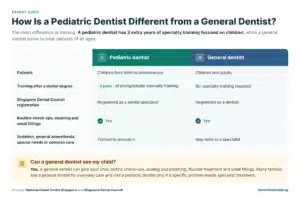
Can a general dentist see my child?
Yes. A general dentist can give your child routine check-ups, scaling and polishing, fluoride treatment, and small fillings. Many families see a general dentist for everyday care and visit a pediatric dentist only if a specific problem needs specialist treatment.
When Does a Child Need a Pediatric Dentist?

Your child may benefit from a pediatric dentist if they:
- have tooth decay in several teeth, especially at a very young age
- have a dental injury, such as a knocked-out or broken tooth
- have special healthcare needs, such as autism or a medical condition that affects dental care
- are too anxious or too young to sit through treatment
- need treatment under sedation or general anaesthesia
- have teeth that are developing unusually, such as missing or extra teeth
When Should Your Child First See a Dentist?

Bring your child for their first dental check-up as early as age one. The Health Promotion Board recommends early dental checks from 1 year old, so the dentist can check your child’s teeth and advise you on the right use of fluoride toothpaste. This first visit does not need to be with a pediatric dentist. See our guide to your child’s first dental visit for what to expect.
FAQs About Pediatric Dentists
What age does a pediatric dentist treat?
A pediatric dentist treats children from birth to adolescence. In Singapore, the National Dental Centre Singapore describes paediatric dentistry as care for “children from birth to adolescence”.
Is a pediatric dentist the same as an orthodontist?
No. Both are dental specialists, but an orthodontist specialises in straightening teeth and correcting the bite with braces and aligners, for patients of any age. A pediatric dentist cares for all of a child’s dental needs and may provide early orthodontic treatment before referring to an orthodontist for braces.
What is a pedodontist?
A pedodontist is another name for a pediatric dentist. Both terms describe a dentist who specialises in children’s oral health.
Is a pediatric dentist worth it for routine check-ups?
For most healthy children, a general dentist can handle routine check-ups and cleaning. A pediatric dentist is most worthwhile when your child has complex decay, special needs, a dental injury, or finds dental visits very difficult.
Choosing the Right Dentist for Your Child
For most children, a general dentist is the right place to start. Book a routine check-up from age one, keep up regular visits, and see a pediatric dentist when your child needs specialist care, such as treatment for extensive decay, a dental injury, or treatment under sedation. A routine check-up is a good first step, and the dentist can advise whether your child needs specialist care.
If your child needs specialist care, ask our dentist about a referral. Find your nearest WeSmile Dental clinic and book your child’s check-up today.