
Dental Crowns in Singapore: Cost, Types & Medisave Guide

Finding out you need a dental crown in Singapore often comes with a mix of questions. You might wonder if the procedure is painful, how much it will set you back, or if there is a way to avoid it entirely.

At WeSmile Dental, we see this as a turning point for your oral health. A dental crown is more than just a cosmetic cap; it is a custom-engineered restoration designed to safeguard a tooth that can no longer support itself. By fully encasing the visible part of your tooth, a crown restores its original shape, size, and strength, ensuring you can chew and smile with confidence again.

Dental crown

What is a Dental Crown and Why is it Necessary?

A dental crown acts as a protective shield for a tooth that has been compromised by decay, trauma, or extensive dental work. While a filling replaces a small part of a tooth, a crown covers the entire surface above the gum line.

Understanding the Tooth Cap Anatomy

Think of a crown as a custom-fitted helmet for your tooth. It is a hollow, tooth-shaped restoration that sits over the remaining natural tooth structure. Once cemented, it becomes the new outer surface of your tooth. At WeSmile, our philosophy is that every crown should be a masterpiece of engineering. We don’t just cap a tooth to hide a problem; we use it to reinforce the foundation, ensuring the pressure of your bite is distributed evenly so the tooth doesn’t split later.

When do you actually need a Dental Crown?

There are several clinical scenarios where a crown is likely to be the most appropriate choice for your oral health:

  • Protection: To hold together parts of a cracked tooth or protect a weak tooth from breaking.
  • Restoration: To rebuild a tooth severely worn down (common with teeth grinding or bruxism).
  • Post-Root Canal: After a root canal, a tooth becomes brittle. A crown provides the necessary strength to prevent it from shattering.
  • Cosmetic & Support: To cover misshapen teeth or anchor a dental bridge.
happy-teeth-a

Dental Crown Material & Cost Comparison

The material of your crown is the most significant factor in both its price and its lifespan. At WeSmile Dental, we provide a range of materials to ensure that every patient can find a solution that fits their clinical needs and budget.

Material & Cost Guide

Dental crown procedures at our clinic typically range from $950 to $1,250 onwards. This price varies based on the restoration’s complexity and the type of material chosen.
Dental Crowns in Singapore

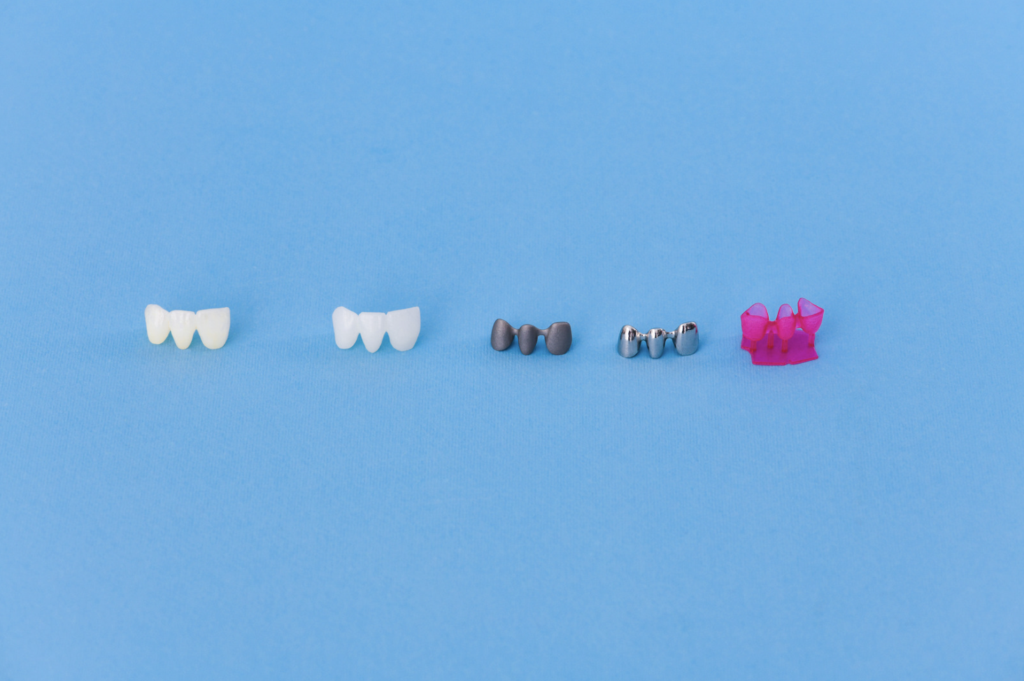
The main types of materials used for dental crowns include:

  • Porcelain Fused-to-Metal (PFM) Crowns ($1,035.50 – $1,500): PFM crowns combine the structural strength of a metal base with a porcelain exterior for aesthetics. They are often less costly than full ceramic options. However, a small grey line may become visible at the gumline over time as the gums naturally recede.
  • Metal Crowns ($1,362.50 – $2,500+): These are the traditional standard for durability. They are highly resistant to breaking and wear, making them ideal for out-of-sight molars. While they are incredibly long-lasting, they are less common today for patients who prefer a tooth-coloured smile.
  • Porcelain Crowns ($1,000 – $1,800): These provide a very natural look and are a classic option for front teeth. Because no metal is used, the treatment is bio-compatible and aesthetic. However, they may not be as resilient as Zirconia if you have a habit of grinding your teeth.
  • Zirconia Crowns ($1,362.50 – $2,500): A relatively modern material in dentistry, Zirconia provides an excellent combination of strength, durability, and aesthetics. Being metal-free, they are white in nature and appear less likely to cause allergic reactions. These are ideal for both front and back teeth.
  • E-Max (Lithium Disilicate) Crowns ($1,500 – $2,000+): This is a high-strength ceramic crown that is both durable and natural-looking. Its superior translucency makes it a top candidate for front teeth restorations, though it is strong enough for the back of the mouth as well.
happy-teeth-a

Managing Your Out-of-Pocket Expenses

While the price for a crown may seem high, subsidies can lower your out-of-pocket costs. From October 2025, CHAS subsidies for permanent crowns have been enhanced:
  • CHAS Blue: Up to $615 subsidy per crown.
  • CHAS Orange: Up to $410 subsidy per crown.
  • Pioneer/Merdeka Generation: Up to $625 subsidy per crown.
Additionally, as of mid-2026, seniors aged 60 and above can now tap into their Flexi-Medisave to offset up to $400 per year specifically for permanent crowns and root canal treatments. This means for a standard PFM or Zirconia crown, your final out-of-pocket payment could be significantly lower than the listed clinic price.

Frequently Asked Questions About Dental Crowns

Q: Is the dental crown procedure painful?

During the treatment, you should not feel any pain. We use local anaesthesia to completely numb the area. You might feel a slight pinch during the initial injection and some pressure, but it is not a sharp experience. Post-treatment sensitivity is normal for 48 hours and can be managed with over-the-counter relief.

Q: Can I eat normally after getting a dental crown?

The short answer is yes, but you should wait until the anaesthesia has completely worn off before your first meal. Attempting to eat while your mouth is still numb can lead to accidentally biting your cheek or tongue.
  • First 24 Hours: The dental cement needs time to reach its full strength. We recommend avoiding very sticky foods (like caramel or gum) and extremely hard or crunchy items (like ice or nuts) during this initial window.
  • The Adjustment Period: For the first day or two, it is often more comfortable to chew on the opposite side of your mouth and stick to softer foods like pasta, eggs, or fish.
  • Long-Term: Once the crown has fully settled (usually after 48 to 72 hours), you can return to your normal diet. However, to preserve the life of your crown, we suggest avoiding habits like biting your fingernails or opening packaging with your teeth.

Q: How long does a dental crown typically last?

While a crown is built to be durable, it is not a set and forget solution. On average, dental crowns are expected to last between 5 to 15 years. However, with the right care and high-quality materials like Zirconia or E-max, many patients find their crowns can serve them for 20 years or more.

Q: Can a tooth still decay under a dental crown?

A common worry is that the tooth will rot under the cap. This typically only occurs if the crown has a poor fit or if oral hygiene is neglected, allowing bacteria to seep underneath. During your six-monthly check-ups, we check the margins of your crown to ensure the seal remains airtight and the tooth underneath stays healthy.

Q: How do I know if I need a crown, a filling, or a veneer?

The right choice depends on the extent of the damage to your tooth:
  • Fillings: Best for small cavities. However, if a filling takes up more than half the tooth, it acts like a wedge that could eventually split the tooth under pressure.
  • Veneers: These are thin porcelain covers for the front surface only. They are excellent for cosmetic beauty but do not provide the structural support a crown offers for weakened or root-canal-treated teeth.
  • Crowns: The preferred choice for teeth that are cracked, severely worn, or have lost significant structure.

Q: What happens if I delay getting a recommended crown?

A weakened tooth is like a house with a cracked foundation. If the tooth splits vertically down to the root, a crown can no longer save it. At that stage, the only option is extraction followed by a more expensive dental implant or bridge.

Why Choose WeSmile Dental for Your Crown?

At WeSmile Dental, we believe that high-quality dentistry should be accessible and stress-free. Our team of multi-lingual doctors ensures that you are fully aware of your options at every step. Whether you visit us in Ang Mo Kio, Bedok, or Orchard, you’ll find transparent pricing and patient-centric care.

Start your journey to a healthier smile by booking your visit here.

Book your Smile Analysis today.